
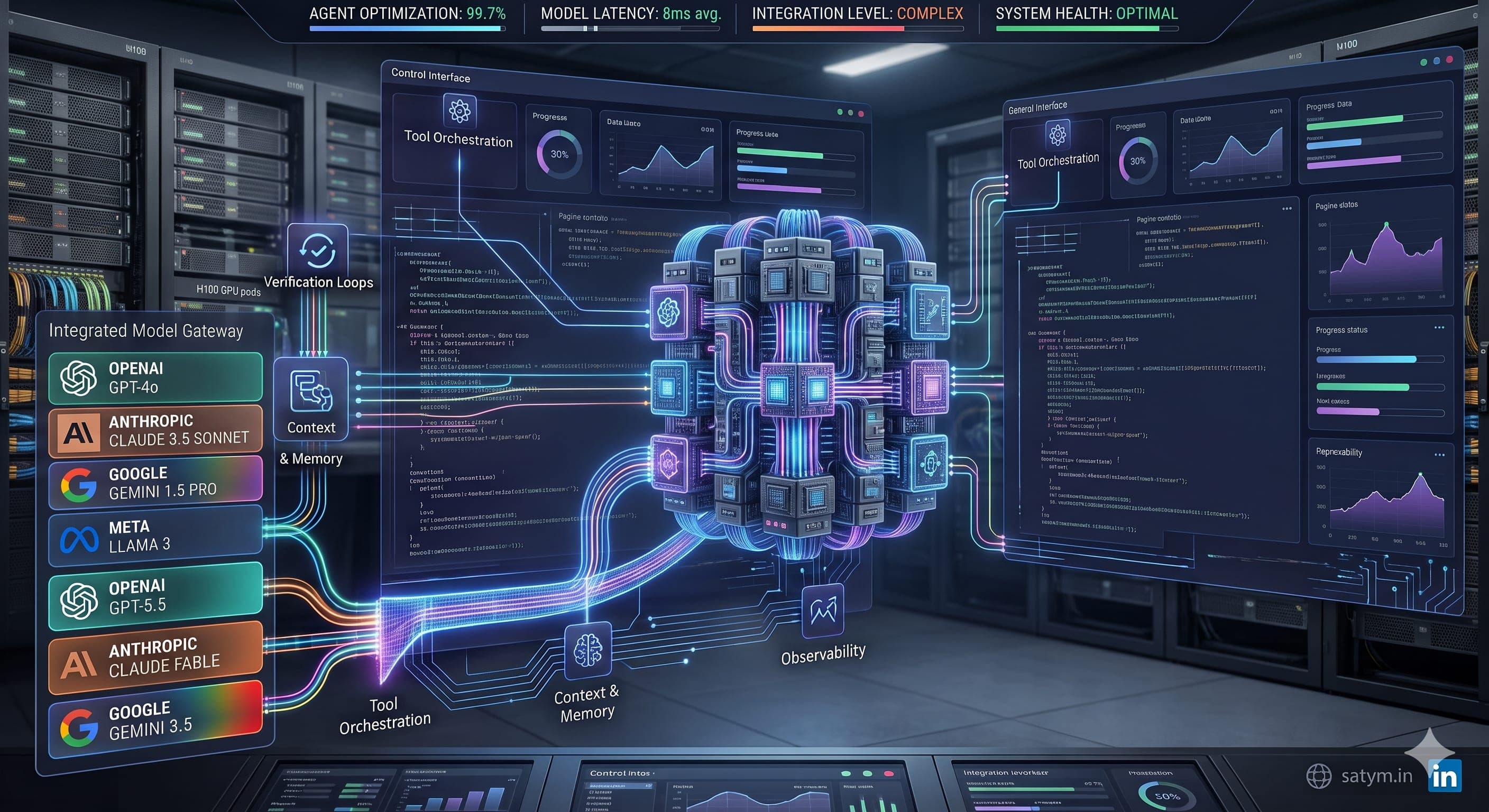
AI Harness Engineering: Why the Model Was Never the Hard Part
Harness engineering is the emerging discipline of building the verification loops, memory systems, guardrails, and observability stack that make AI agents relia
Satyam Singh
AI Harness Engineering: Why the Model Was Never the Hard Part
### Everyone's obsessed with picking the right LLM. The engineers actually shipping in production are obsessed with something else.
---
There's a number that keeps coming up in 2026 engineering conversations: 88% of AI agent projects never reach production.
Not because the model was bad. Because the system around the model was brittle, unmonitored, and built on assumptions that collapsed the moment real users showed up.
I've been building ML systems for a while — a distributed ranking engine, deep learning pipelines for satellite image segmentation, an ML-powered WAF. The pattern is always the same:
> The model is the easy part. What breaks you is everything else.
That "everything else" has a name now: the harness.
---
## So What Even Is a Harness?
The term comes from horse tack — reins, saddle, bit. Equipment for channeling something powerful in the right direction.
The horse is your LLM. The harness is everything you build around it.
> Agent = Model + Harness
Most teams spend 90% of their energy on the left side. The teams actually shipping reliable products obsess over the right side.
## Why Prompts Aren't Enough Anymore
Prompt engineering was a workaround that held up when tasks were simple and single-step. Production AI today looks like multi-step reasoning chains, live API calls, mid-execution error recovery, and human checkpoints before anything irreversible happens.
> That's not a writing problem. That's an infrastructure problem.
---
The Five Layers That Actually Matter
Layer 1 — Tool Orchestration
What tools can the agent call, what can each one access, and what happens when a call fails? Most teams build this and stop. That's the mistake.
Layer 2 — Verification Loops
Validation before outputs touch anything downstream — type checkers, output parsers, domain-specific assertions. Skip this and you're trusting the model to always be right. It won't be.
I found this out building a segmentation model where a data leakage issue silently inflated metrics for months. The model was fine. The verification layer didn't exist.
Layer 3 — Context and Memory
LLMs are stateless. If you want the agent to remember step 3 while it's on step 7, you build that yourself — conversation buffers, vector stores, episodic memory. The wrong choice is assuming it'll "just remember."
Layer 4 — Guardrails
Not about making the model "nice." About constraining what it can actually affect — which paths it can write to, which endpoints it can call.
> The LLM figures out what to do. The harness decides what it's allowed to do.
Layer 5 — Observability
Distributed tracing, structured logging, latency percentiles, human-in-the-loop overrides. Treat your AI pipeline like any other distributed system — instrument everything, alert on anomalies, trace every request.
## Where Most Teams Go Wrong
They build Layer 1, demo it, and ship it. Then:
- An API returns an unexpected schema → no validation → the agent hallucinates to fill the gap
- A task fails at step 4 → no checkpointing → restarts from scratch, user billed twice
- Prompts drift over a week → no observability → nobody notices until a customer complains
Every one of these is a harness failure, not a model failure.
## The Mental Model Shift
A framing that's stuck with me: "Anytime an agent makes a mistake, engineer a solution so it never makes that mistake again." Most of the time, that solution is a harness improvement — not a model upgrade, not a prompt tweak.
Your reliability compounds over time instead of resetting every model release.
> The engineers who figure this out early are going to have a serious advantage over the ones still chasing the next model drop.
The harness is where the real work happens. Most teams haven't started building it.
See what I'm working on at satym.in or connect on https://www.linkedin.com/in/satym5512/.